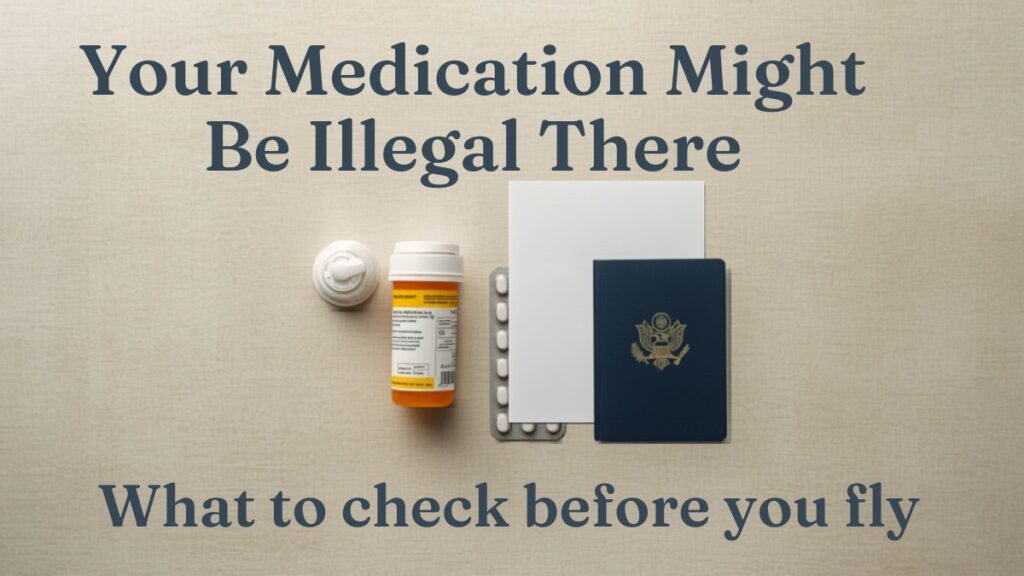
You have a prescription from your own doctor, filled at your own pharmacy, for a condition you have had for years. That prescription has no legal force whatsoever once you land somewhere else.
This is the part travelers find hardest to believe, so it is worth stating bluntly. Several medicines that are ordinary at home are controlled substances or outright prohibited elsewhere, and holding a valid foreign prescription does not change that. People are stopped at borders over this every year. Some are detained.
The good news is that this is almost entirely a paperwork problem, and paperwork problems are solvable if you start early enough.
Why your prescription does not travel
Each country writes its own drug schedules. A substance sitting in a low-control category at home can sit in a high-control category, or on a prohibited list, at your destination. Border officers apply their own country’s law.
Japan’s own guidance to visitors is unusually direct about this: a valid foreign prescription for a medicine that is illegal in Japan does not protect you, and bringing it risks arrest and detention. Other countries are less explicit but no more forgiving.
There is a documented case from 2015 of a traveler detained in Nagoya over a supply of ADHD medication, held for over two weeks. The medicine was legally prescribed where she lived. It is a stimulant that is prohibited in Japan.
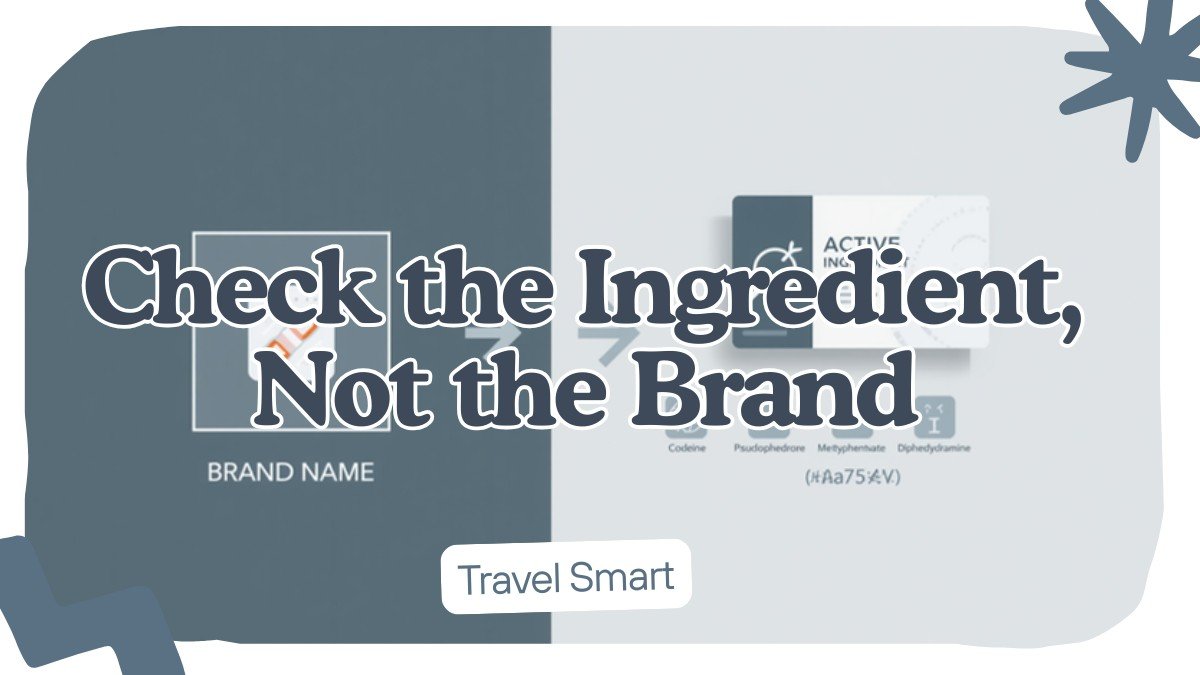
Check the ingredient, not the brand.
This is the single most useful habit in this whole area.
Brand names differ between countries and mean nothing to a customs officer or a legal schedule. What is regulated is the active ingredient. Read the small print on the box, find the ingredient name, and check that.
This matters most for over-the-counter products, because nobody thinks to check those. A cold and flu tablet or an allergy capsule bought without a prescription at home can contain an ingredient that is tightly controlled elsewhere.
The categories that catch people out
This is not a complete list, and it is not a substitute for checking your specific medicine against your specific destination. It is a list of the things that most often go wrong.
- ADHD medication. Stimulants such as methylphenidate and amphetamine-based medicines are among the most restricted drugs in the world. Some countries require advance permits. Japan prohibits certain amphetamine-based ones outright, regardless of prescription.
- Strong painkillers. Codeine, tramadol, oxycodone and morphine are controlled in many countries and frequently require documentation or advance authorization. Codeine in particular appears in ordinary cough and pain products in some countries and is heavily restricted in others.
- Sleep and anxiety medication. Benzodiazepines such as diazepam and clonazepam are commonly controlled and commonly require paperwork.
- Ordinary cold and allergy remedies. Pseudoephedrine, the decongestant in many cold products, is restricted or prohibited in several countries. Some antihistamines are restricted too. These are the ones people never think to check.
- Anything cannabis-derived, including CBD. Legality at home is irrelevant. Several countries treat all cannabis-derived products as prohibited narcotics, with severe penalties, and a medical prescription does not exempt you.
Penalties vary enormously. In parts of Southeast Asia and the Middle East, drug offenses carry sentences far heavier than most visitors imagine, and enforcement does not always distinguish neatly between a genuine patient and a trafficker at the point of arrest.
Countries that require advance permission
Some destinations operate a formal import permit system. If yours does, this is the step that needs planning around, because it has a lead time.
Japan
Japan operates an import confirmation certificate, long known as the yakkan shoumei and now also referred to as a yunyu kakunin-sho. It is generally required for controlled medicines, for quantities above roughly a one-month supply, and for larger amounts of injectables including insulin.
Applications need to be submitted well in advance, commonly cited as at least two weeks before arrival. Narcotics are handled through a separate narcotics license process. Japan’s Ministry of Health, Labor and Welfare is the authority, and they answer email inquiries about specific medicines.
United Arab Emirates
The UAE controls a wide list including strong painkillers, some cold medicines, sleep and anxiety medication, and ADHD medication. Prior permission from the health authority is required for some categories, quantities are typically limited to a few months’ supply, and documentation is expected.
Singapore
Singapore requires prior approval for certain controlled medicines and enforces its drug laws with exceptional severity. If your medication falls into a controlled category, do not travel on the assumption that a prescription will be enough.
Others worth checking carefully
China, Indonesia, Saudi Arabia, South Korea, Greece and Mexico all have restrictions that regularly surprise visitors. This is not an exhaustive list, which is rather the point: check yours specifically rather than working from any list, including this one.
The transit trap
Here is the part almost nobody thinks about. If you change planes in a country, that country’s laws apply to what is in your bag.
A connection through a strict jurisdiction can be a legal problem even though you never intended to enter it, particularly if you clear immigration, collect bags, or your luggage is screened during the transfer. If you are routing through a hub with severe drug laws, check the transit country as well as the destination.
If your itinerary involves a long connection, our guide on whether you can leave the airport on a layover covers when you formally enter a country and when you do not.
What to carry, and what not to do
- Keep everything in original labeled packaging. The label connects the medicine to you and to a prescriber. This is the most important single thing.
- Carry a copy of the prescription, showing the medicine, the dosage, and your name.
- Carry a letter from your doctor naming the medicine, the active ingredient, the dosage, and confirming it is for your personal use. Some countries expect this translated.
- Carry any required permit, and a printed copy, not only a version on your phone.
- Pack medication in hand luggage. Checked bags go missing, and a delayed bag with your only supply in it is its own emergency.
Do not decant tablets into an unlabelled pill organizer for a trip abroad. It is convenient, it is common, and at a border it turns identifiable prescribed medicine into unidentified loose tablets. In the Nagoya case mentioned earlier, repackaging out of the original container reportedly made the situation worse.
Do not post or courier medication to yourself at your destination either. Shipping controlled substances across a border is generally treated far more seriously than carrying a personal supply, and it removes every mitigating factor you would otherwise have.
How to actually check, in the right order
- Write down the active ingredient of everything you intend to take, prescription and over-the-counter alike.
- Check your destination’s own government source. The health ministry or customs authority of the country you are visiting is the authority. Not a blog, not a forum.
- Check the embassy of your destination in your own country. They handle exactly this question and will usually answer in writing, which is worth having.
- Check any transit countries the same way.
- Talk to your own doctor or pharmacist about alternatives if something is prohibited. There is often a substitute that is not controlled at your destination, but that is a clinical decision, and it needs time.
Start this at least a month before departure if any of your medicines are in a controlled category. Permit systems have lead times, embassies are slow, and changing a prescription is not something to rush.
Quick answers
Does a doctor’s letter make a banned medicine legal?
No. A letter supports a permitted or restricted medicine. If a substance is prohibited outright, no letter changes that, and you will need to discuss alternatives with your doctor.
Do these rules apply to over-the-counter medicine?
Yes, and this is where people most often get caught, because nobody expects a cold remedy to be a problem.
Does it count if I am only changing planes?
It can. Transit countries apply their own laws to what you are carrying. Check them as well as your destination.
How much can I bring?
It varies. Many countries permit a supply reasonably matched to the length of your stay, often around one to three months, with anything more requiring a permit. Check the specific limit for your destination.
Is CBD treated differently from cannabis?
Often not. Several countries treat cannabis-derived products as prohibited regardless of THC content or medical status at home. This is one of the fastest ways to get into serious trouble abroad.
This fits into the wider set of things worth sorting early. Our pre-trip checklist covers what to handle and when, from passport validity through to entry authorizations.
This article is general information, not medical or legal advice. Drug schedules and import rules change and vary by nationality and destination. Never stop or change prescribed medication because of something you read online. Confirm your specific medicines with your doctor and with the official health or customs authority of every country you will enter or transit.