

Disclosure: some links in this guide are affiliate links. If you book through them, we may earn a small commission, at no extra cost to you. It does not change what we recommend or what you pay.
Cheap flights land at unsociable hours. That is largely why they are cheap.
The saving is real, but it comes with a cost nobody quotes you at booking: you arrive in an unfamiliar country at the exact moment when the trains have stopped, the information desks are shut, and the only people still working the arrivals hall are the ones who make their living from tired travelers with no plan.
An hour of preparation removes almost all of it.
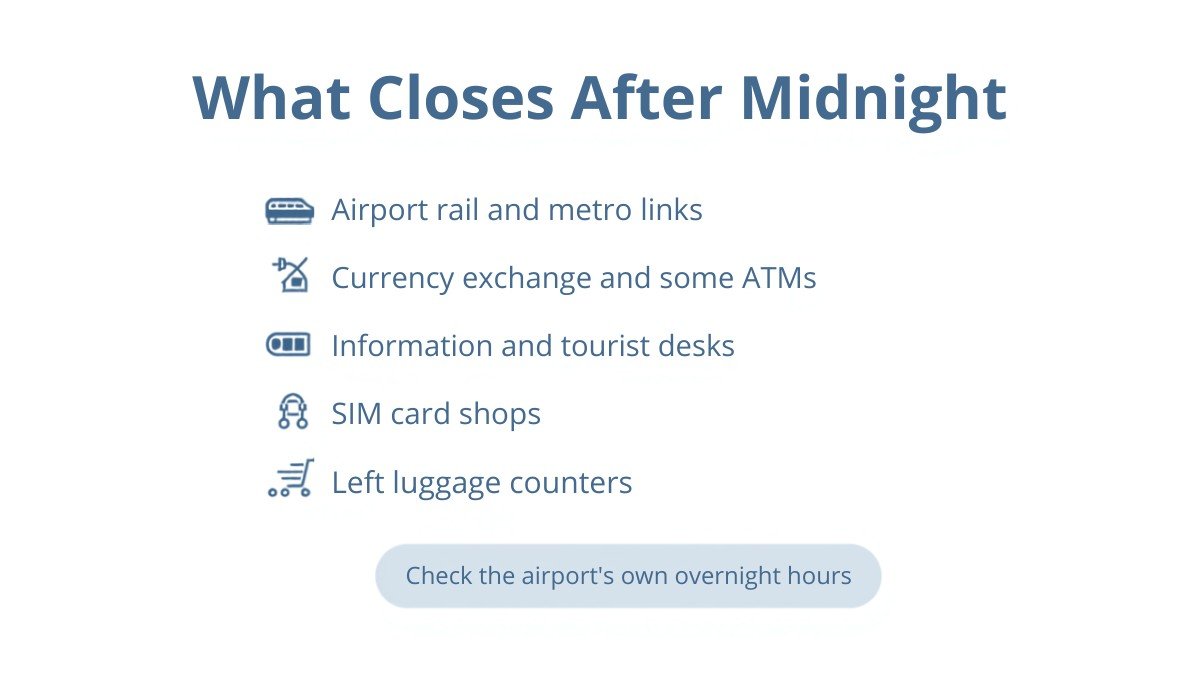
What shuts down after midnight
Airports stay open. Almost everything inside them does not.
- Rail and metro links. The airport express that every guide recommends usually stops running well before midnight and restarts around five. This is the one that catches people out most.
- Currency exchange and some ATMs. Not all run around the clock, and a cash-only taxi rank plus a closed ATM is a genuinely awkward combination.
- Information desks and tourist counters. The people who would normally tell you which taxi rank is the official one have gone home.
- SIM card shops. Frequently closed overnight, which matters if your plan was to buy data on arrival.
- Left luggage. Some desks close overnight, so an early onward connection may not be as flexible as you assumed.
Check the airport’s own website for overnight hours rather than assuming a major hub runs everything continuously. Plenty do not.
Decide your route before you board
The single most useful thing you can do is arrive already knowing how you are getting out. Not roughly. Specifically: which service, from where, and what it should cost.
Decisions made in an arrivals hall at two in the morning, jet-lagged, are the expensive ones. Decisions made on your sofa are not.
Have a primary and a backup. Flights are late, bags are slow, and the night bus you were counting on may have left. A backup removes the moment of standing at the curb improvising.
Your realistic options
- Night bus. Usually cheapest where it exists, and usually the least pleasant with luggage. Check it actually runs on the night you land, since some services are weekday only.
- Official taxi rank. Straightforward at most airports, provided you use the marked rank rather than anyone who approaches you inside the terminal.
- Ride-hailing app. Convenient where it operates, but pickup zones at airports are often in a distant car park, and late-night pricing can surge sharply.
- Pre-booked transfer. Fixed price agreed in advance, driver tracking your flight, and someone waiting when you walk out. The most predictable option, and the one that removes the most decisions at the worst moment.
The arrivals hall at 2 am
Unlicensed drivers work night arrivals deliberately, because the conditions favor them: you are tired, the official desks are closed, and you have not decided what you are doing.
The patterns are consistent worldwide.
- Approaching you inside the terminal. Legitimate taxis wait at a rank. Someone walking up to you offering a ride is, at best, not the official service.
- The broken meter. Followed by a fare several times the going rate. Agree a price before getting in, or insist on the meter.
- Invented surcharges. Luggage fees, night fees, airport fees, appearing at the end of the journey. Ask about extras before departing.
- Your hotel is closed. A driver claims your accommodation has shut down or is full, and offers somewhere better. It is a commission arrangement. Ask to be taken where you booked.
- The note swap. You hand over cash, the driver claims you gave a smaller note. Count aloud, and try to carry smaller denominations.
None of this requires suspicion of everyone. Knowing roughly what the fare should be, and where the official rank is, defuses almost all of it.
Money and data before you land
Two things you cannot easily sort out at three in the morning.
Data. An eSIM activated before you land means you have maps, translation, and a ride from the moment you clear immigration. Buying a local SIM on arrival is usually cheaper for longer stays, but only if the shop is open, which overnight it often is not.
Cash. Find out before you travel whether your destination is effectively cashless or still runs on cash. Airport exchange desks offer consistently poor rates and may be closed anyway. Carrying a small amount of local currency for the first ride is worth the minor cost.
Tell your accommodation you are arriving late
This is the step people skip, and it is the one that leaves them outside a locked door.
Smaller hotels and guesthouses do not always staff reception overnight. Many will happily leave a key, provide a door code, or arrange a late check-in, but only if they know. Message them with your flight number and expected arrival, and get a reply confirming it.
Also check whether your booking has a latest check-in time. Some do, and arriving after it without warning can be treated as a no-show.
When the airport hotel is the right answer
Sometimes the best plan is not to travel at all until morning.
If you land at two, your accommodation is an hour away, and you have an early start, the cost of a night near the airport can be less than a long transfer plus the sleep you lose. It is also the safer option arriving somewhere unfamiliar for the first time, and worth considering if you are traveling alone.
A short list for the night before
- Route decided, primary and backup, with the approximate fare written down.
- Accommodation told of your arrival time and confirmed it.
- Address saved in the local language as a screenshot.
- Offline map downloaded.
- Data sorted, phone fully charged, power bank in your carry-on.
- Small amount of local cash, in small notes.
- Someone at home knows your flight and arrival plan.
Quick answers
Is it safe to arrive at an airport at night?
Airports themselves are generally among the safer places to be at night. The risk sits in the journey out and in improvising it while exhausted.
Can I just sleep in the terminal until morning?
At some airports, yes; at others, landside areas close overnight. Check the specific airport before relying on it.
Will there be taxis at 3 am?
At major airports, almost always. Waits can be longer and fares higher, and the official rank is the one to use.
Should I book a transfer or use an app?
An app is usually cheaper where it operates reliably. A pre-booked transfer is more predictable, which matters more the less familiar the destination and the later the hour.
Arriving well is part of a larger set of things worth sorting early. Our pre-trip checklist covers what to handle and when.
Transport schedules, airport opening hours and fares change. Confirm current details with the airport and your accommodation before you travel.