
It is gone. The hotel safe, the day bag, the back pocket on a crowded metro—it does not matter much which. What matters now is that you cannot leave the country you are standing in, and you are about to deal with two bureaucracies at once.
This is a solvable problem, and it is solved thousands of times a week. But the order you do things in matters, and one of the steps has a consequence almost nobody warns you about.
Step 1: Report it to your own government immediately
Not to the local police first. To your own passport authority.
Most countries let you do this online, and reporting cancels the passport, typically within about one business day. That cancellation is the point: a stolen passport is a valuable identity document, and the window between theft and cancellation is when it is worth something to whoever took it.
Here is the consequence people are not warned about. Once you report it as canceled, that passport is permanently dead. If it turns up in a coat pocket an hour later, it is still dead. Traveling on a canceled passport can result in you being denied exit from the country you are in or denied entry at your destination.
That is not a reason to delay. It is a reason to look properly first, and then commit. Do not report it while you are still half-hoping, and do not wait a day either.
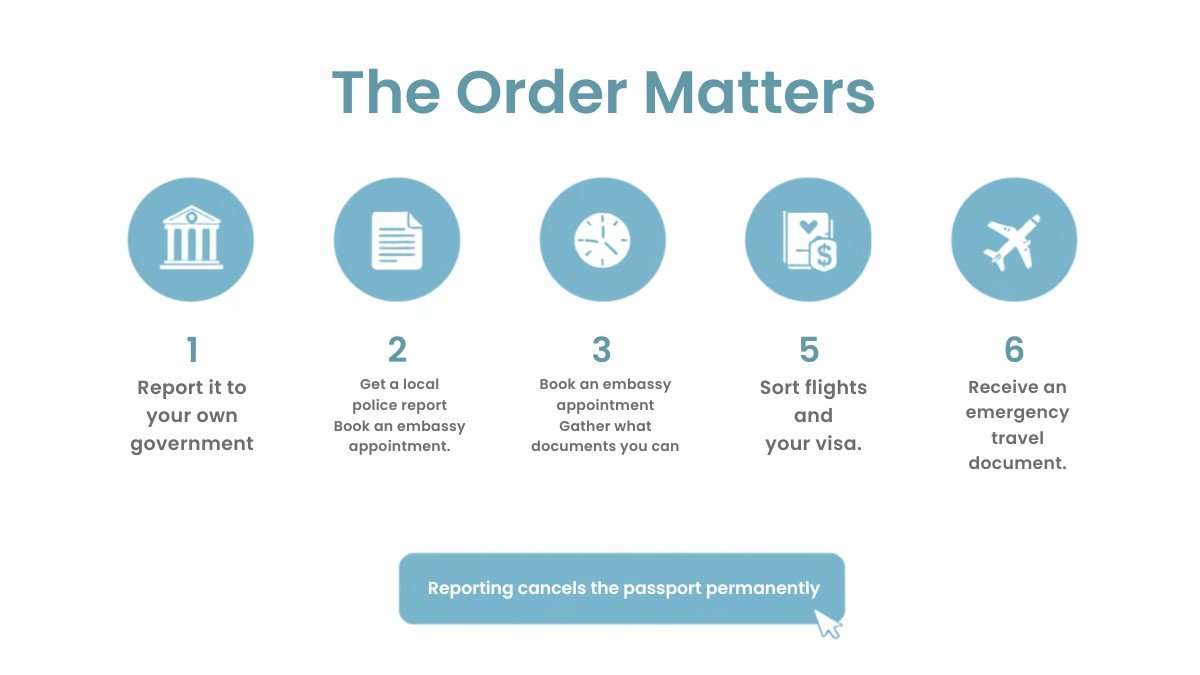
Step 2: Get a police report
Whether this is strictly required varies by nationality. Some governments treat issuing a replacement as optional. That framing misleads people, because the police report matters for other reasons:
- Travel insurance. Most policies will not pay for replacement fees, extra hotel nights, or rebooked flights without one, and many require it to be filed within a short window of the theft.
- Replacing a visa. If your passport contained a visa or an entry stamp, that is a separate process with the country you are in, and the report is usually central to it.
- Proving the timeline. If the document is later misused, an official record of your report protects you.
Your accommodation is the practical shortcut here. Front desk staff generally know which station handles this and can help with translation. Bring whatever identification you still have, along with any copy of the passport data page. Ask for a written copy of the report before you leave, and expect the process to be slower and more formal than you are used to.
Step 3: Contact your embassy or consulate
Find the nearest mission for your nationality and book an appointment. Most operate by appointment rather than on a walk-in basis.
The timing trap: embassies close on weekends and on both local and home-country public holidays. After-hours numbers exist but are reserved for genuine emergencies, and a stolen passport with no imminent flight generally is not one. A Friday evening theft can realistically mean Monday.
If you have a flight in the next forty-eight hours, say so when you make contact. Urgency is handled, but only if they know about it.
Step 4: Assemble what you can
Requirements differ by country, but the pattern is consistent.
- A completed application form, usually downloadable in advance.
- Passport photographs to the correct specification. Embassies can often point you to a nearby photo shop.
- Proof of citizenship. A photocopy or photograph of the lost passport is commonly accepted for this purpose, even though it is not valid for travel.
- Any other identification you still hold.
- The police report, if you have one.
- Evidence of onward travel, such as a booking confirmation.
- A means of paying the fee. Replacement is generally not free.
If everything was stolen together, go anyway. Consular staff deal with this exact scenario constantly, and there are procedures for applicants who cannot produce documents because they were in the same bag. Not having the checklist is not a reason to delay the appointment.
Step 5: Understand what you will actually receive
Often not a normal passport.
Where there is time and full documentation, some countries issue a standard full-validity replacement. Where there is not, you get an emergency travel document: limited validity, sometimes restricted to a specific route home or to named countries, exchangeable for a proper passport once you are back.
This matters if your trip was supposed to continue. An emergency document may not allow you to proceed to the next country on your itinerary, and it may not be accepted for a visa. If you had onward plans, ask about this specifically at the appointment rather than assuming.
Step 6: Deal with the knock-on effects
Your flights
Contact the airline early. With a police report and a confirmed embassy appointment, many carriers will waive change fees in these circumstances, but that is discretionary and depends on you asking.
Your visa
This is the step most guides omit entirely. A new passport does not carry your old visa or your entry stamp. In a country where you entered on a visa, you may need that visa to be transferred or reissued by local immigration before you can legally leave, and leaving without resolving it can create problems at the border. Ask the embassy about the local process.
Your identity
If cards were taken along with the passport, freeze them immediately; it is faster in a banking app than by phone. Then watch for misuse. Stolen identity documents are not always used straight away.
The twenty minutes that make all of this easier
Everything above is faster if you do three things before leaving home:
- Photograph your passport data page and store it somewhere reachable without your phone, since the scenario worth preparing for is losing both together. A cloud account you can open from a borrowed computer is the answer.
- Save the address and number for each country’s embassy on your route. Nobody looks this up calmly.
- Carry a second form of photo identification, stored separately from your passport. A driving license in a different bag materially speeds up everything at both the police station and the embassy.
Quick answers
How long does a replacement take?
Sometimes, a single business day for an emergency document with complete paperwork. Longer where documents are missing, where the mission is busy, or across a weekend or holiday.
Can I fly home on a photocopy?
No. A copy helps prove citizenship when applying for a replacement. It is not a travel document, and neither is a passport number alone.
What if my passport turns up after I report it?
It is canceled and cannot be used. Continue with the replacement.
Do I really need the police report?
For the replacement itself, sometimes not. For your insurance claim and for replacing a visa, usually yes. Get one.
Can I continue my trip, or do I have to go home?
It depends on what you are issued. A full replacement usually lets you continue. An emergency travel document may be limited to a route home. Ask at the appointment.
Preparing for this belongs with everything else worth sorting before departure. Our pre-trip checklist covers what to handle and when to handle it.
Passport replacement procedures, fees, and documentation requirements vary by nationality and by country, and they change. Confirm current details with your own government’s passport service and your nearest embassy or consulate.