

Disclosure: Some links in this guide are affiliate links. If you book through them, we may earn a small commission, at no extra cost to you. It does not change what we recommend or what you pay.
You are at check-in with a one-way ticket. Then the agent asks how you intend to leave the country you are flying to.
This catches people out. After all, it feels like a question immigration should ask on arrival, if anyone asks at all. In practice, however, the airline asks first. And the airline is the one more likely to stop you.
Why the airline cares more than immigration does
The reason is money. Under long-standing industry rules, the airline must fly you back if a country refuses you entry. On top of that, it usually pays a fine to the receiving country.
That is the whole explanation. The airline carries a financial risk that immigration does not. As a result, it screens harder. A border officer might well have waved you through. But the check-in agent never finds out because you did not board.
Airlines also work from a shared industry database of entry requirements. The system checks your nationality and ticket automatically at check-in. If it flags an onward ticket rule, the agent has very little discretion.
One practical consequence follows from this. Budget carriers are often the strictest because the fines are large relative to their margins.
Where it is genuinely enforced
Enforcement varies. It depends on your nationality, your route, your airline, and sometimes the individual agent. So treat any list as a guide to where you should check. It is not a definitive answer.
| Level | Where | What to expect |
|---|---|---|
| Consistent | Philippines, Thailand, Indonesia, Vietnam, Malaysia, Costa Rica, New Zealand | Officers check almost every arrival |
| Frequent | Peru, Brazil, Colombia, Panama, Mexico | Airlines often verify before boarding |
| Situational | US, UK, Schengen, Australia, India | Asked only when something draws attention |
Southeast Asia is the strictest region overall. The Philippines, in particular, has a well-earned reputation for it.
The situational group deserves a note. These countries ask less often. However, the consequences bite harder because you have usually reached a border rather than a check-in desk.
Separately, many visa applications require a flight itinerary as a supporting document. That applies regardless of what happens at the border. In other words, it is a documentation requirement rather than an enforcement one, and it is not optional.
What counts as proof
More than people assume. Importantly, “onward” does not mean “home”.
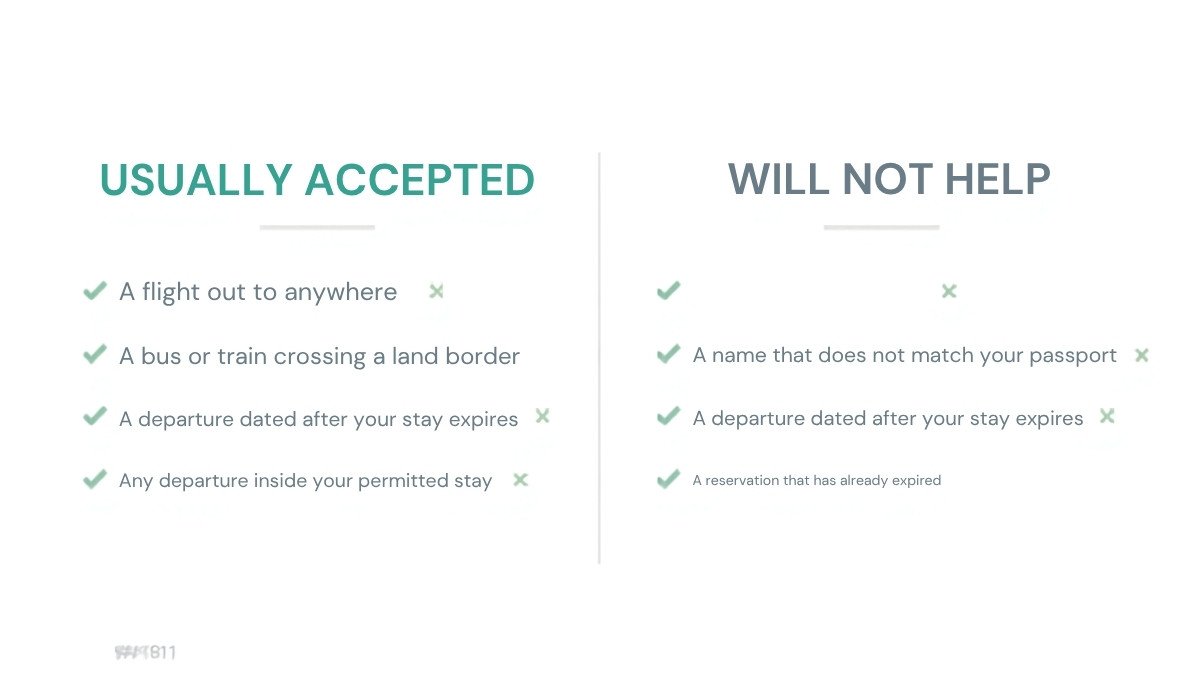
- A flight out to anywhere, not necessarily your country of residence.
- A bus or train booking that crosses a land border, where such travel is plausible in the region.
- A ferry ticket.
- A confirmed itinerary showing that you will depart within your permitted stay.
Agents assess two things. First, do you have a way out? Second, does that departure fall inside your permitted period?
That second point matters more than people realize. A departure dated after your visa-free allowance expires is worse than no departure at all. In effect, it signals that you plan to overstay.
Your details also need to line up. The name must match your passport exactly. Likewise, the dates should fit the rest of your trip.
When to sort it out
Timing is worth considering, because the answer is not simply “as early as possible.”
Book a real onward flight when you book the inbound one, if your plans are settled. Prices are lower, and the whole question disappears.
If your plans are genuinely open, wait until closer to departure. Even then, do not leave it at the airport. Sort it the night before at the latest. Buying a ticket under pressure at a check-in desk is how people end up paying several times the going rate.
One more habit is worth building. Before you fly, look up the cheapest routes out of your destination. Consequently, if you are ever challenged, you already know what to book.
Your options, honestly compared
Book a cheap real onward flight
Some regions have dense budget networks. There, a genuine ticket to a neighboring country can cost very little. For example, Bangkok to Kuala Lumpur or Bali to Singapore satisfies the requirement. Meanwhile, you avoid committing to an expensive long-haul date.
This is the cleanest option for three reasons. It is true. It survives scrutiny. And if your plans change, you have lost a small sum rather than created a problem.
Buy a fully refundable ticket
Buy it, show it, then cancel it after arrival. This is legitimate, and it works.
That said, the drawbacks are practical rather than ethical. Your money is tied up until the refund clears, which can take weeks. You also have to remember to cancel within the window. Finally, check that the fare is genuinely refundable, not merely changeable.
Use the 24-hour cancellation window
Rules for tickets bought in the United States generally allow free cancellation within 24 hours of booking. Departure must be at least seven days away. Timed carefully, this can cover a check-in.
However, it is fiddly and easy to get wrong. It also doesn’t help if immigration asks you again upon arrival.
Onward ticket rental services
A number of services sell a temporary reservation for a small fee. You get a booking reference that stays live for a short period.
We are not going to pretend these do not exist. Equally, we are not going to recommend them. Be clear about what you are buying: a reservation that will expire, rather than a ticket.
Some are genuine held bookings. Others are considerably less solid. Furthermore, the marketing around this category is aggressive because the margins are good. And if the reference does not verify when an agent checks it, you are worse off than if you had arrived with nothing. At that point, it looks deliberate.
So if your onward plans are genuinely undecided, consider the alternative. A cheap real ticket to a neighboring country usually costs a little more. Crucially, it carries none of this risk.
If you are stopped at check-in
Stay calm. Treat it as a documentation problem, because that is what it is. Arguing about whether the rule should apply will not help. The agent is following a database entry rather than exercising judgment.
Show any onward booking you have, including overland travel. If you have nothing, you can usually buy something on your phone at the desk. This is precisely why knowing the cheap routes out is worth ten minutes of preparation.
What happens if you are refused
It helps to know the actual consequences, since they differ depending on where you are stopped.
Refused at check-in. You do not board. The airline may log your ticket as a no-show, so you lose the fare. Oddly enough, this is the cheaper failure, because you are still at home.
Refused on arrival. This hurts considerably more. Border officials usually hold you until the next flight back. Moreover, you generally pay for that flight yourself, and you may lose your accommodation bookings too.
Officials may also record the refusal. Subsequently, you may need to declare it on future visa applications for that country, and sometimes for others as well. That is the real reason to take this seriously.
Quick answers
Does it have to be a flight back to my own country?
No. Any credible departure within your permitted stay generally counts. That includes a flight to a neighboring country.
Does a bus or train ticket count?
Often, yes, crossing that land border makes sense. However, agents question it more often than they question a flight.
Will immigration check as well as the airline?
Sometimes. In the strictest countries, both check. So keep the booking accessible after you land. Do not delete it at the gate.
What if I am transiting rather than entering?
Staying airside usually avoids the question. But if you clear immigration or collect bags, the transit country’s rules can apply.
Are one-way tickets a problem in themselves?
Not inherently. Nevertheless, they trigger the question. Agents rarely ask about a return booking.
How long should the gap be before my onward flight?
Your onward date must fall within your permitted stay. Beyond that, no fixed rule applies. A date near the end of your allowance is fine, provided it does not exceed it.
This belongs with the other entry requirements worth confirming before you book. Our pre-trip checklist covers what to sort and when to do it.
Entry requirements vary by nationality and change frequently. Confirm with the official immigration authority of your destination and with your airline before you travel.